





Accessing your favorite playlists and albums shouldn't require downloading heavy software or carrying your personal laptop everywhere you go. The Apple Music Web Player offers a streamlined, browser-based solution that brings your entire audio library to almost any device with an internet connection. Whether you are using a locked-down work computer, a lightweight Chromebook, or a portable mobile device, this platform ensures your Apple Music is always readily available.
Mastering the Apple Music Web Player ensures your favorite tracks are always just a click away. In this expert review, we analyze the latest web interface, key features, user guide, and how it stacks up against rising subscription costs from rivals like Spotify. More importantly, we will introduce an excellent solution to download music from Apple Music Web Player.
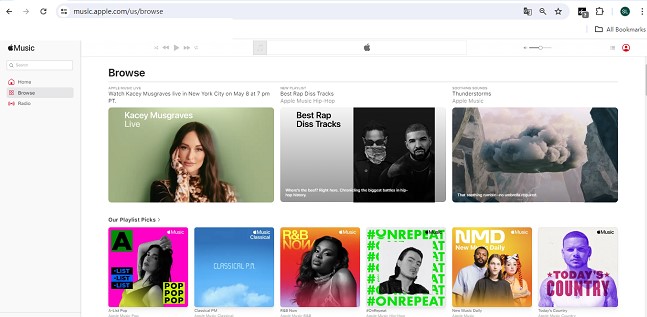
Part 1. What Is Apple Music Web Player?
The Apple Music Web Player is a high-performance, browser-based Progressive Web App (PWA) located at music.apple.com. It serves as more than just a backup; it is a full-featured portal that bypasses the need for local software installations. It allows Apple Music users to allowing you to stream high-quality audio directly through Chrome, Edge, Firefox, or Safari web browsers. This flexibility extends across operating systems, meaning it functions perfectly on Windows, macOS, iOS, Android, Chrome OS, and even Linux environments.
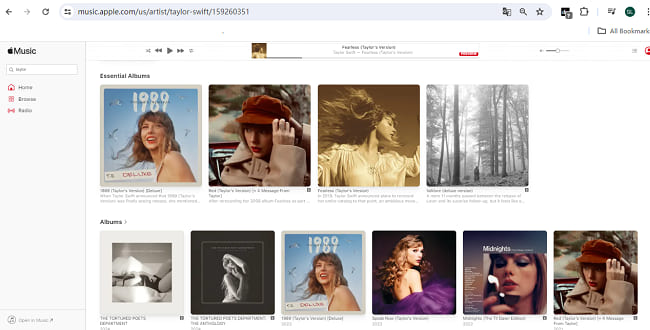
Key Features & Technical Specs of Apple Music Web Player
- Library Access: Once you authenticate with your Apple Account, you will find an interface that closely mimics the polished look of the native applications. You retain full access to essential tabs like Listen Now, Browse, and Radio, alongside your meticulously organized personal library. You can listen to Apple Music on your web browser directly.
- AI AutoMix Integration: Apple Music online player now supports AutoMix, which uses machine learning to beat-match and transition tracks seamlessly, perfect for keeping the energy up during work hours.
- Lyrics Translation: The web player now features real-time, AI-powered Apple Music lyrics translation, allowing you to understand foreign language tracks as they play.
- Search 2.0: Enhanced with Apple Intelligence, the search bar now understands natural language.
Part 2. The Trade-offs: Apple Music Web Player Quality and Offline Playback
To provide a genuinely helpful guide, we must address the technical limitations you will encounter when moving away from the dedicated apps. The most notable difference lies in audio fidelity; currently, the Apple Music web player delivers audio quality at a standard bitrate of just 128kbps AAC (Sometimes 256kbps). This is a step down from the 256kbps standard offered on mobile and desktop apps, and it completely lacks support for the Apple Lossless Audio Codec (ALAC) or High-Res Lossless formats.
Another significant limitation is the complete inability to download Apple Music tracks for offline listening. Because the player operates entirely within a browser tab, a persistent and stable internet connection is absolutely mandatory for playback. If you are preparing for a long flight or heading into an area with spotty cellular service, you will still need to rely on your mobile device to cache those files.
Part 3. How to Use the Apple Music Web Player
Using the Apple Music web player is a straightforward process, allowing you to access your entire music library, playlists, and more from any compatible web browser. Here's a step-by-step guide on how to use the Apple Music web player:
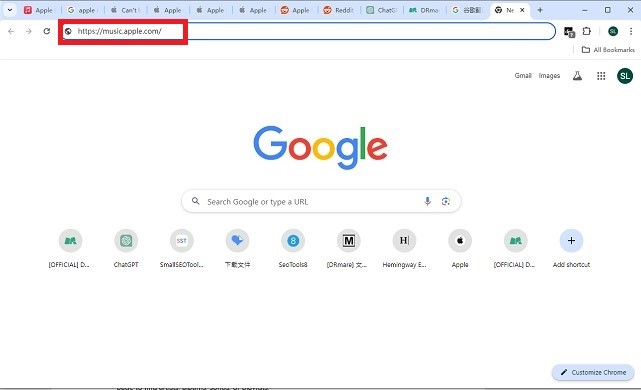
Step 1. Visit the Apple Music on Web Browser: Open any modern web browser, such as Chrome, Firefox, Safari, or Edge. You also need to ensure your browser is up to date to avoid compatibility issues. Navigate directly to the official URL at music.apple.com.
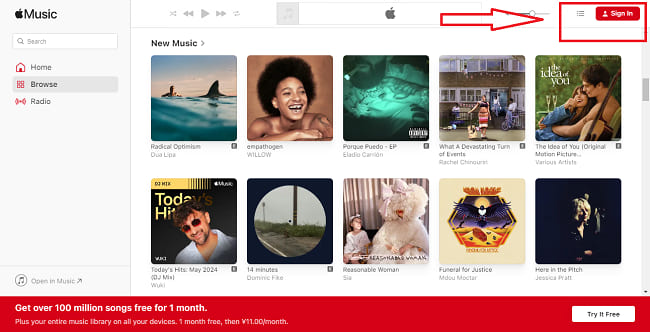
Step 2. Sign In Apple Account: Click on the "Sign In" button located in the top right corner of the screen and authenticate using your Apple Account name and password.
Step 3. Explore the Interface and Search for Music: Complete any two-factor authentication prompts required by your Apple account to safely unlock your music library. Use the search bar at the top of the page to find artists, albums, songs, or playlists.
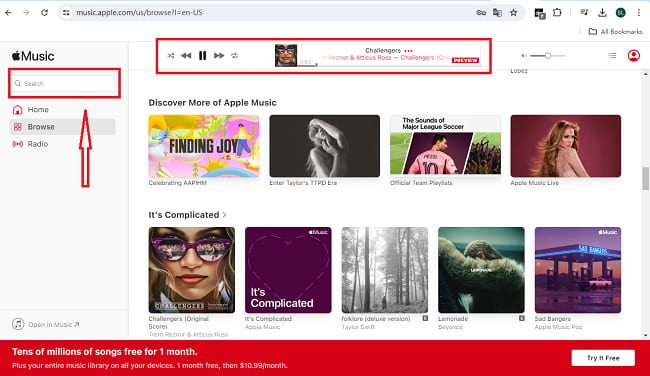
Step 4. Play Apple Music on Web Player: Click on a song, album, or playlist to open it. Then, press the "Play" button to start listening.

Once logged in, the interface will be familiar to anyone who has used Apple Music on other devices. You can browse your library, search for new music, and manage playlists directly from your browser.
Pro Tips: Pin as PWA:
For the best experience, click the "Share" or "Menu" button in your browser and select "Add to Dock" or "Install App". This gives you a dedicated window and media key support (Play/Pause/Skip) on your keyboard.
Part 4. How to Download Music from Apple Web Player
The future of streaming is browser-based, providing instant access on any device. However, even the most advanced web players share one fatal flaw: They do not support offline downloads. This is a critical limitation for travelers or users in low-bandwidth areas. To bridge this gap, many professionals turn to DRmare Apple Music Converter.
Why DRmare is Essential for Web Player Users:
- Bypass Browser Limits: While the web player caps quality based on your browser, DRmare captures the original 100% Lossless stream.
- True Offline Freedom: Since the web player can't save files, it allows you to convert your Apple Music library into MP3, FLAC, or WAV, making your music playable on any device, even those without a browser.
- Permanent Ownership: Your web player access disappears the moment your subscription ends. DRmare ensures that your curated Apple Music playlists remain yours forever, regardless of your account status.
How to Download Music from Apple Music Web Player
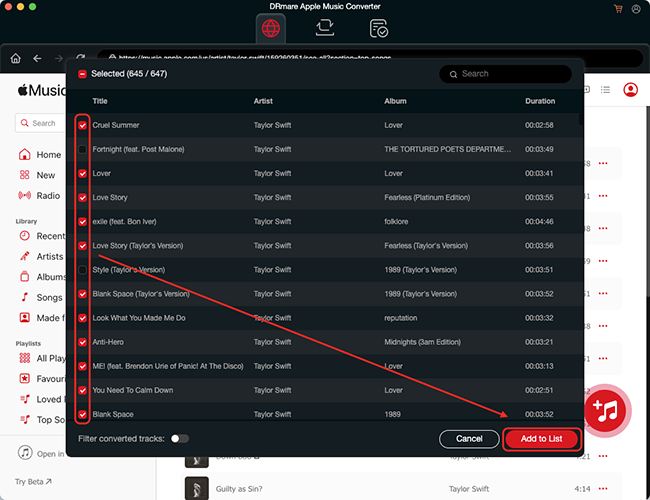
Step 1. Install and open the right version of DRmare Apple Music Converter compatible with your OS. You will see an integrated Apple Music web player to access your library. Authorize your Apple Account and browse your library. Tap the "+" > "Add to List" button to load your favorite songs to the conversion queue.
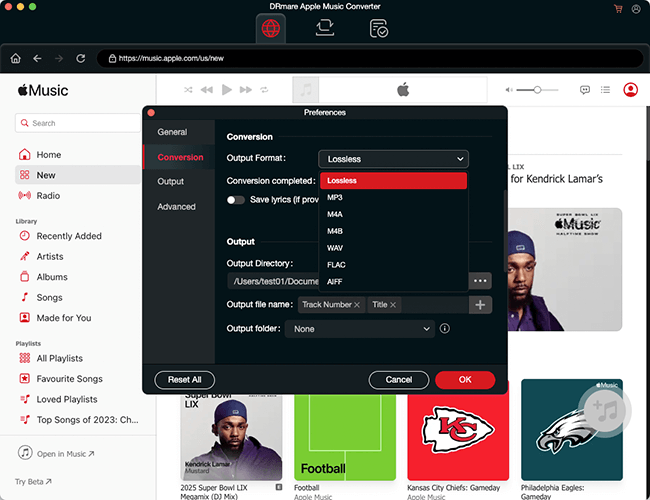
Step 2. Before downloading, you can define your preferred audio quality: Click the "Menu" icon > "Preferences" option. Go to the "Conversion" tab, you can customize the output format, audio parameters, choose how you want files named (e.g., Artist - Title) and where to save them.
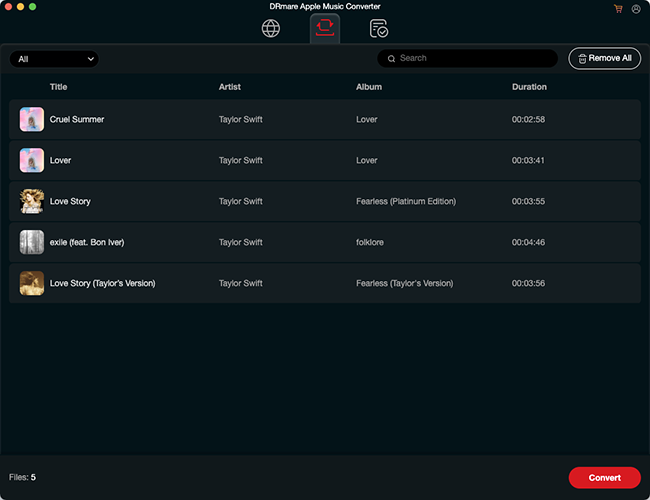
Step 3. Review your list in the "Converting" window. You can click the "Convert" button at the bottom right. Once finished, click the "Converted" icon to view your files. You can also click the Folder icon next to any song to locate the actual file on your computer.
Part 5. How to Fix Apple Music Online Player Not Working
While generally highly reliable, the Apple Music browser version can occasionally suffer from minor syncing delays or playback glitches. Use the following solutions to resolve the most common browser-based issues.
1. Resolve Syncing & Display Errors
If newly added tracks from your iPhone appear as "undefined" or are missing album artwork, your browser may be displaying outdated information.
The Fix: Clear your browser's cache and site data for music.apple.com. This forces the player to fetch a fresh version of your library from the cloud.
2. Bypass the "100-Song Shuffle" Limit
A known quirk of the web player is that the shuffle algorithm often only includes the first 100 songs currently loaded in the browser's view. To ensure your entire massive playlist is scrambled:
Step 1. Open your playlist and scroll all the way to the bottom to force the browser to load every track into active memory.
Step 2. Click the Shuffle button only after the entire list has visually populated.
3. Stop Playback Stalls (Performance Settings)
If your Apple Music stops unexpectedly, it is likely due to "Efficiency Mode" or "Memory Saver" settings in browsers like Chrome or Edge.
The Fix: Go to your browser's Performance or Battery settings and add music.apple.com to the "Always Active" or "Performance Whitelist."
4. End Continuous Login Loops
If the site repeatedly asks you to sign in despite entering the correct credentials:
-
Clear Cookies: Specifically delete cookies for the Apple domain.
-
Check Extensions: Disable AdBlockers or Privacy Shields temporarily, as they can interfere with the security tokens required for authentication.
Part 6. Other Streaming Web Players Comparison: Why Apple Music Wins?
The streaming landscape has shifted. While competitors have hiked prices to cover AI development, Apple has maintained its value proposition through the Apple One bundle.
| Feature | Apple Music Web | Spotify Web | Tidal Web |
|---|---|---|---|
| Individual Price | $11.99 (Value King) | $12.99 | $11.99 |
| Max Audio Quality | AAC 256kbps | AAC 256kbps | HiRes FLAC |
| AI Experience | AutoMix DJ | DJ X / Daylist | Discovery Mix |
| Ecosystem Perk | Apple One Bundle | Hulu/Audiobooks | Artist Direct Payouts |
Expert Insight:
Apple Music is now $2/month cheaper than Spotify Premium. Over a year, switching to Apple Music saves individual users $24, while offering superior audio fidelity on app.
Part 7. FAQs about Apple Music Web Player
Does Apple Music have a web player?
Yes. It allows subscribers to stream their entire library, browse the catalog, and listen to radio stations directly through any modern web browser without installing the app.
What's the Apple Music Web Player sound quality?
The Apple Music web player streams at a maximum of 256kbps AAC. While this provides high-quality lossy audio, the web player does not support Lossless, Hi-Res Lossless, or Spatial Audio (Dolby Atmos), which are currently exclusive to the native applications.
Do I need a paid subscription to use the Apple Music Web Player?
Yes, an active, paid subscription is required to stream full songs, search the catalog, and access your personal library. However, if you only have a standard Apple Account without a paid tier, you can still log in to listen to free live broadcasts like the Apple Music 1 radio station.
Can I manage smart playlists on the web?
While you can freely listen to the smart playlists you have already created on your Mac or PC, the browser version currently lacks the advanced library management tools required to build or deeply edit them. For heavy library curation, returning to the native desktop application remains your best option.
Why Use the Apple Music Browser Version?
The primary advantage of the web player is its universal accessibility and complete lack of installation requirements. It is an incredibly efficient way to keep your workflow uninterrupted while enjoying your personalized mixes. Choosing the browser route is exceptionally useful for a few specific scenarios:
- Bypassing strict IT software restrictions on office computers.
- Saving valuable hard drive space on devices with limited storage capacity.
- Accessing your account quickly on a shared or public computer.
Part 8. Conclusion
The Apple Music Web Player is no longer a lite version of the app, it is a sophisticated, AI-enhanced platform that offers the best price-to-performance ratio. For the daily listener, it provides unmatched convenience. For the power user, combining the web player's accessibility with DRmare Apple Music Converter's permanent archiving power creates the ultimate, fail-safe Apple Music library.

 Home
Home





User Comments
Leave a Comment