





You can use Apple Music on multiple devices with the same Apple Account. However, the catch lies in simultaneous playback. With a standard Individual subscription, Apple Music generally only allows one active stream at the same time. If you hit play on a second device, your first stream will likely pause, accompanied by the message: "It looks like you're listening on another device."
Depending on your actual goal, whether it's independent streaming for family members, whole-house audio, or offline playback across various gadgets, there are three distinct ways to solve this. Let's see how to play Apple Music on multiple devices simultaneously.
Part 1. Can You Use Apple Music on Multiple Devices?
Apple Music can be signed in and accessed on more than one supported device. With Sync Library enabled, your library can appear across an iPhone, iPad, Mac, Windows PC, and other devices signed in with the same Apple Account. What causes confusion is that using Apple Music on two or more devices is not the same as streaming Apple Music on multiple devices at the same time.
Apple Music Multiple Devices vs. Simultaneous Playback
Here is a quick breakdown to help you choose the right approach based on your scenario:
| What You Want to Do | Individual Plan | Family Plan | AirPlay 2 | Local Audio Files |
|---|---|---|---|---|
| Access library on several devices | ✅ | ✅ | — | ✅ |
| Stream different songs simultaneously | Limited to one stream | ✅ | Not its main purpose | ✅ |
| Keep your library synced across devices | ✅ | ✅ | — | Depends on transfer |
| Keep separate personalized recommendations | ❌ (If sharing one account) | ✅ | ❌ | — |
| Play the same song across multiple speakers | ✅ (Via AirPlay) | ✅ (Via AirPlay) | ✅ (Best fit) | ✅ (If manually synced) |
| Listen entirely offline | Downloaded tracks stay tied to the app | Same | — | ✅ (Files stored locally) |
Practical Apple Music Multiple-Device Scenarios
A device-by-device comparison makes the difference clearer.
| Scenario | What Usually Happens | Best Option |
|---|---|---|
| Same Individual account: iPhone plays Song A, Mac starts Song B | One of the Apple Music streams may be interrupted | Family Plan if two people need independent playback |
| Same account on iPhone and Mac, but only one is playing | Works normally | Individual Plan |
| Parent listens on iPhone while another Family member listens on iPad using their own account | Both can listen independently | Family Plan |
| One playlist plays through a HomePod and an AirPlay-compatible TV | Same audio can play across selected outputs | AirPlay 2 |
| MP3 files are copied to a phone and USB player | Each device plays its own local copy | Local audio files |
This is also why seeing "It looks like you're listening to another device" does not necessarily mean you have too many devices linked to your Apple Account. It usually points to another Apple Music stream using the same subscription.
Part 2. How to Play Apple Music on Multiple Devices with Family Plan
For households where two or more people want to listen to different Apple Music tracks at the same time, the Apple Music Family Plan is the most straightforward, official option.
A Family subscription can be shared with up to six people via Apple's Family Sharing group. Instead of everyone muddying up a single music profile, each person uses their own Apple Account. This means everyone gets their own separate library, listening history, personalized playlists, and algorithmic recommendations.
How to Set Up Apple Music Family Subscription
Step 1. Open the Apple Music app and go to Home.
Step 2. Select your subscription or trial offer and choose See More Plans.
Step 3. Select Family, sign in with your purchasing Apple Account, and confirm your billing information.
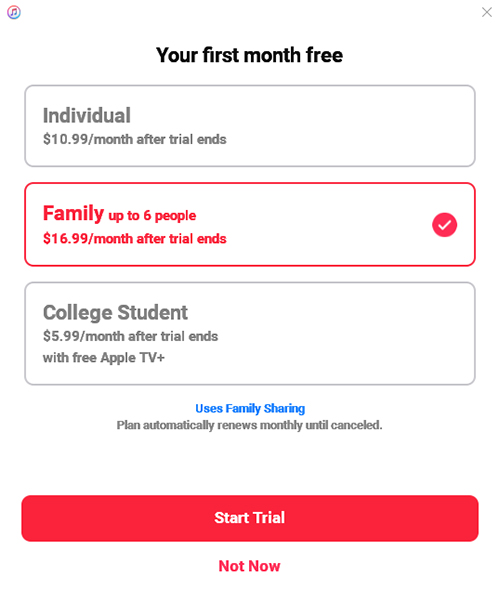
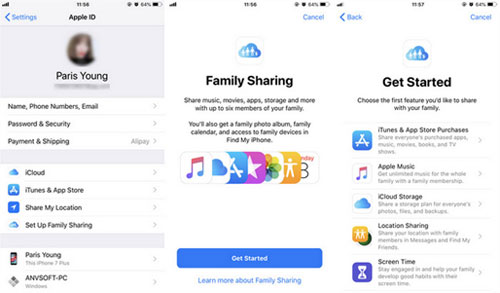
Step 4. Invite family members via Family Sharing in your device settings. Each member must sign in using their personal Apple Account to keep their listening data separate on multiple devices at the same time.
Tips:
If you already have an Individual subscription, the family organizer can switch the existing subscription to Family instead of creating a separate account.
Note:
Pricing varies by region, but in the U.S., an Individual plan is currently $11.99/month, while the Family plan is $19.99/month.
Part 3. How to Listen to Apple Music on Multiple Speakers with AirPlay 2
If your goal is to have the same playlist booming through the living room, kitchen, and bedroom simultaneously, you don't need an Apple Music Family Plan. You need AirPlay 2.
AirPlay 2 can cast audio to multiple compatible speakers, Apple TVs, or smart TVs on the same Wi-Fi network. It is designed for synchronized multi-room playback, not for playing different songs independently.
How to Play Apple Music on Multiple Speakers (iOS/iPadOS):
Step 1. Ensure your iPhone/iPad and AirPlay speakers are on the same Wi-Fi network.
Step 2. Start playing a song in Apple Music.
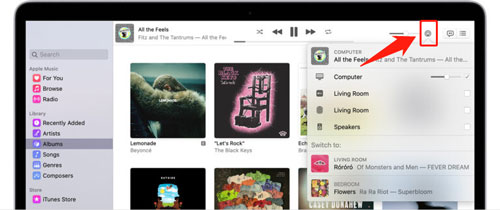
Step 3. Open the Control Center and tap the AirPlay icon in the playback widget.
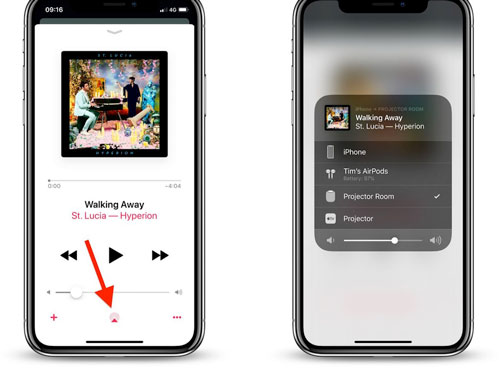
Step 4. Select every compatible speaker or TV you want to broadcast to. The current audio can then play through the selected devices.
Pro Tip for Mac Users:
When streaming directly from the Apple Music app on a Mac, you can select multiple speakers via the app's internal AirPlay icon. The general Sound controls in the macOS Control Center do not offer this same multi-speaker functionality.
Part 4. How to Play Apple Music Files on Multiple Devices Offline
Not every multi-device scenario requires an active internet connection or a live Apple Music stream. If you want to play your music on an MP3 player, an older car stereo via USB, or just want to keep local copies to avoid streaming limits entirely, converting tracks to standard audio files is the best route.
In that situation, DRmare Apple Music Converter provides a different approach. Rather than changing the simultaneous streaming allowance of an Apple Music subscription, it converts selected Apple Music tracks into local audio files that can be transferred and played separately.
Note:
This distinction is worth keeping clear: local playback and multiple Apple Music streams are two different things.
DRmare supports output formats including MP3, FLAC, WAV, AIFF, M4A, and M4B, making the converted files easier to use with common media players and storage devices. The conversion speeds is at up to 30X, depending on the computer and content being processed. For users who mainly want independent offline playback, this can be more flexible than keeping every device tied to an active Apple Music session.
- Step 1Add Apple Music to DRmare
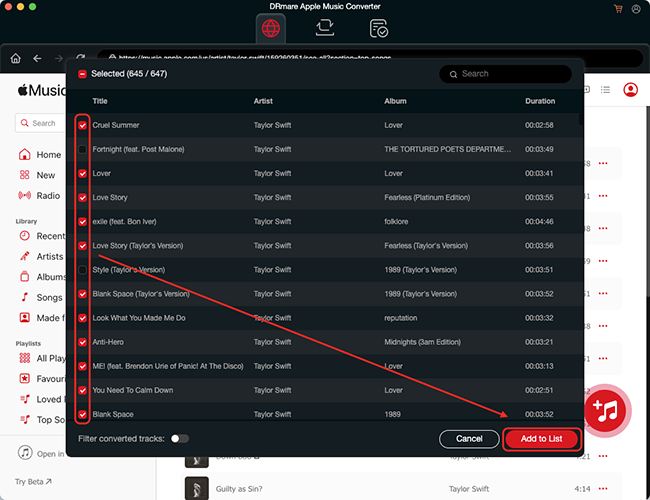
- Launch the DRmare Apple Music Converter and use the built-in Apple Music Web Player to sign in to your Apple account. Once logged in, browse your library, playlists, or albums directly within the software interface. When you find the content you want to convert, click the red '+' > 'Add to List' button to load the tracks into the conversion queue.
- Step 2Adjust Apple Music output format
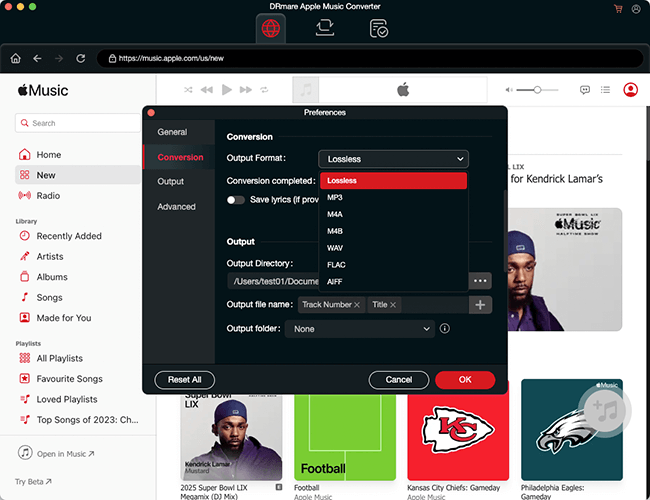
- Please find the 'Menu' or 'DRmare Apple Music Converter icon at the top and click on it. And then you can customize the output format, channel, codec, and so on. The default output format is Lossless (MP3 or M4A), which is the most commonly used format, so you don't need to reset.
- Step 3Convert Apple Music for offline playback
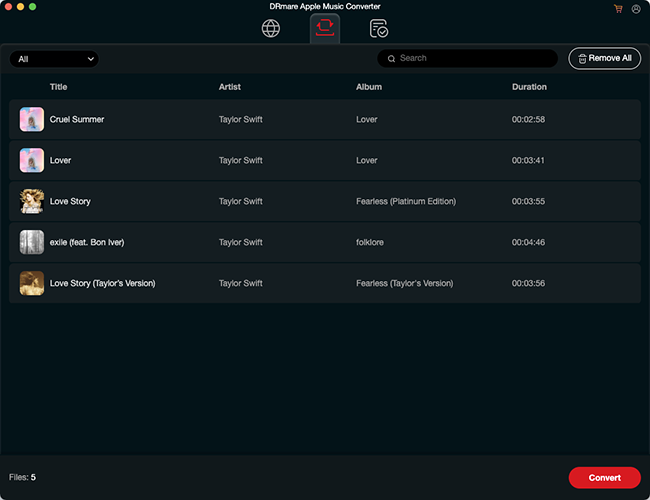
- Finally, touch on the 'Convert' button and DRmare Apple Music Converter will launch the conversion process immediately. Once finish the conversion, you could go to the 'Converted' button to check the local Apple Music files on your computer.
- Step 4Listen to Apple Music on multiple devices
- Now you have owned the common Apple Music files, you can easily transfer them to other devices. You can use a USB drive, USB cable, or Bluetooth to transfer converted Apple Music files to any other device you want. Then you can listen to Apple Music on an unlimited number of devices at the same time.
These devices then play the resulting local files independently. This does not add more simultaneous live streams to the Apple Music subscription itself.
Part 5. Fix "It Looks Like You're Listening on Another Device" on Apple Music
If Apple Music suddenly stops and reports that another device is listening, first determine whether another device is actively streaming with the same individual Apple Music subscription. Here is how to fix it:
-
Hunt Down the Rogue Stream: Check any iPad, Mac, Windows PC, or Apple TV signed in with your Apple Account. Pause the music on that secondary device.
-
Check Your Smart Speakers: It is incredibly easy to forget that a HomePod or an Apple TV might be silently streaming in another room. Check your AirPlay playback controls to ensure the audio is actually stopped.
-
Stop Sharing Accounts: If a sibling or partner is using your Apple Account on their phone to listen to music, this error will happen constantly. Transition them to a Family Plan using their own Apple Account.
-
Restart or Re-Sign In (With Caution): If you absolutely cannot find another device playing, close and reopen the Apple Music app. Signing out of your Apple Account and signing back in can also force the session to refresh.
Critical Warning:
When you log out of Apple Music, all downloaded music for offline listening will be immediately removed from your device, and you will need to re-download them. However, do not panic. Your Apple Music playlists, library, and listening history are completely safe and tied to your Apple Account in the cloud. Everything will reappear when you sign back in.
Part 6. FAQs about Apple Music on Multiple Devices
Can I use the same Apple Music account on two devices?
Yes. You can sign in and sync your library across both phones. However, an Individual plan only allows one active stream at a time. Pressing play on Phone B will pause the music on Phone A.
How many devices can play Apple Music at the same time?
The number of devices that can listen to Apple Music at the exact same time depends entirely on your subscription plan and how you are listening.
- Individual Plan: 1 device at a time.
- Student Plan: 1 device at a time.
- Family Plan: Up to 6 devices at the same time.
Does AirPlay 2 count as multiple streams?
No. Sending one song to five different AirPlay 2 speakers in your house counts as a single Apple Music stream.
Can two people listen to Apple Music at the same time?
It depends on the setup. An Individual subscription generally allows one Apple Music stream at a time. A Family subscription supports multiple family members listening on their own devices, while AirPlay 2 can send audio to multiple compatible speakers or TVs.
Can you log into Apple Music on multiple devices?
Yes. You can sign in with the Apple Account associated with the subscription on multiple devices and enable Sync Library if you want your music library to appear there as well. Your library can then remain available across supported devices even though simultaneous streaming rules still apply.
Part 7. Conclusion
Using Apple Music on multiple devices is usually easy; the part that causes confusion is simultaneous playback. An Individual subscription works well when one person moves between a phone, computer, tablet, or TV, while the Family Plan is better suited to several people who want independent streams. AirPlay 2 fills another role by sending music across compatible speakers and TVs.
If the goal is instead to keep selected music as local files for independent offline playback on devices such as USB players, car stereos, or portable media players, converting the tracks to a common audio format provides a different route. Choosing between these methods becomes much simpler once you separate device access, simultaneous streaming, multi-room playback, and local playback.

 Home
Home





User Comments
Leave a Comment