





You've spent months, maybe even years, curating the perfect Spotify playlists. You have a meticulously organized mix for the gym, the ultimate late-night drive soundtrack, and a nostalgic collection you guard with your life. But what happens if you accidentally delete one, or worse, lose access to your account? Poof. All that hard work is gone.
To secure your Spotify music library, you need a solid backup strategy. Can you back up Spotify playlists? Yes, but the right method depends on what you want to preserve. Whether you want a simple text file of your tracks or a complete offline library, here are four proven ways to back up and restore your Spotify playlists, from Spotify's own data export to third-party backup tools and dedicated library backup software.

Method 1. Backup Spotify Playlist with Spotify's Download Your Data
If you want to start with Spotify's own tools, Download Your Data is the most straightforward option. Spotify provides account data in a ZIP archive containing JSON files. Depending on the data package, playlist-related information can include playlist names, modification dates, track names, artists, albums or episodes, descriptions, follower counts, and other account information. This method is incredibly safe but heavily favors archiving over easy restoration.
How to Download Your Spotify Playlist Data
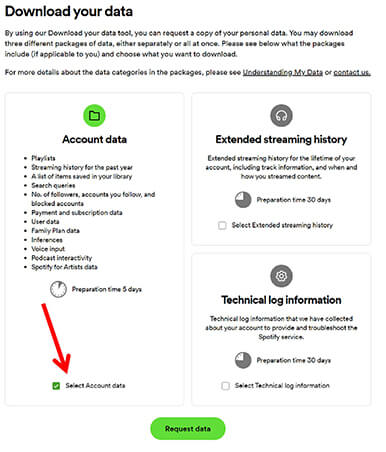
- Go to your Spotify Account page in a web browser.
- Navigate to Privacy settings and scroll down to Download your data.
- Click Request data to request the available account data package. Spotify will eventually email you a ZIP file containing various JSON files.
- When Spotify prepares the archive, download the ZIP file.
- Extract the archive and inspect the JSON files for your playlist information.
The Verdict:
The resulting files are structured data rather than a ready-to-import Spotify playlist. If you need to restore a playlist later, you may have to use the track information to recreate it.
Method 2. Backup Spotify Playlist with SpotMyBackup
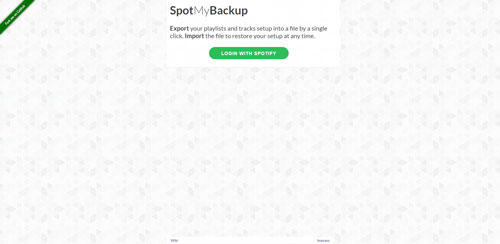
SpotMyBackup was designed specifically around a simple Spotify playlist backup and restore workflow. Its interface still presents options for exporting playlists and tracks to a file and importing that file later. The traditional workflow is straightforward.
How to Backup Spotify Playlist with SpotMyBackup
- Open SpotMyBackup in your browser and choose the LOGIN WITH SPOTIFY option to log in with Spotify.
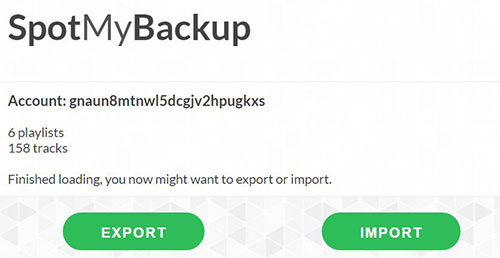
- Authorize the requested Spotify access and wait while your Spotify playlists and tracks are scanned.
- Select Export to save the generated JSON file somewhere safe. The JSON file is intended to act as a snapshot that can later be imported back through the service.
How to Restore a Spotify Playlist from SpotMyBackup
- Open SpotMyBackup and sign in with Spotify.
- Choose Import to select your previously exported JSON file.
- Follow the restoration process.
- Check Spotify to make sure the playlists and tracks were recreated as expected.
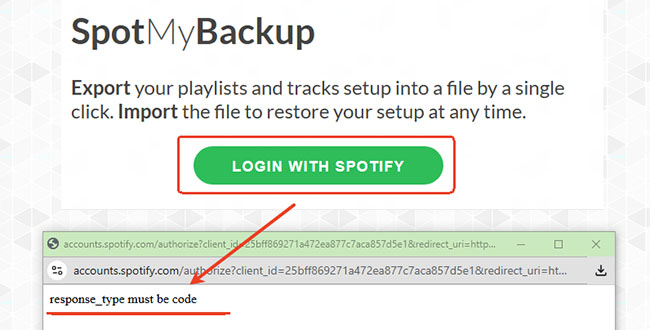
Updated: SpotMyBackup Not Working Now
The service currently appears to have compatibility issues with Spotify's authentication system. During our test, it was unable to log in and received the Spotify OAuth error: response_type must be code. Because of this, SpotMyBackup no longer works reliably for current Spotify accounts. If you encounter this error, use one of the alternative backup methods below instead.
Method 3. Export Spotify Playlists to CSV, TXT, or Excel
For many users, exporting playlists to a readable file is the most practical form of backup. Several tools follow essentially the same idea: connect Spotify, select your playlists, export the track information, and keep the resulting file locally. Here are the popular options:
- TuneMyMusic & Soundiiz: They allow you to export your Spotify playlists to TXT or CSV formats, capturing the song title, artist, and album. Best of all, they feature built-in "Import" tools, making it incredibly easy to upload that CSV later and restore your playlist automatically.
- Exportify: Exportify outputs a CSV that includes advanced metadata like Spotify track URIs, ISRCs, and exact release dates. That URI is a magic key if you ever need to manually search and restore specific tracks.
- FreeYourMusic: Takes a unique approach by exporting your playlist directly into an Excel (XLSX) format, making it super easy to visually sort and review your tracks offline.
| Tool | Main export format | Useful for | Restore option |
|---|---|---|---|
| Exportify | CSV / ZIP | Detailed Spotify metadata and track URIs | Yes, with a manual Spotify workflow |
| TuneMyMusic | CSV / TXT | Simple playlist backup and re-import | Yes |
| Soundiiz | CSV / XML / JSON / TXT / XSPF / URL | Structured backups with format flexibility | Yes |
| FreeYourMusic | XLSX | Excel-based playlist backup | Yes |
Instead of repeating almost identical instructions for every service, here's how the common workflow works.
General Workflow for Spotify Playlist File Backup
- Choose a playlist export service and connect or authorize your Spotify account when required.
- Select the playlist or playlists you want to save and start the export.
- Choose the available file format and save the exported file to your computer or another storage location.
- Keep a second copy if the playlist is particularly important.
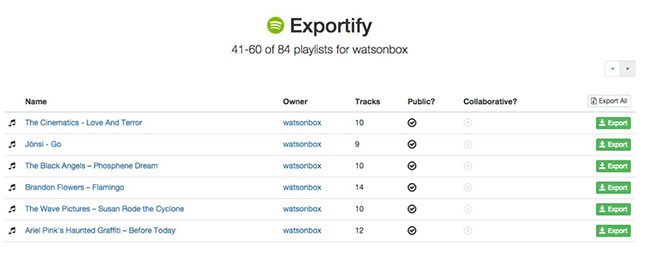
The main difference between these tools is what they put into the file and how easily that file can be used for restoration.
Security Tip:
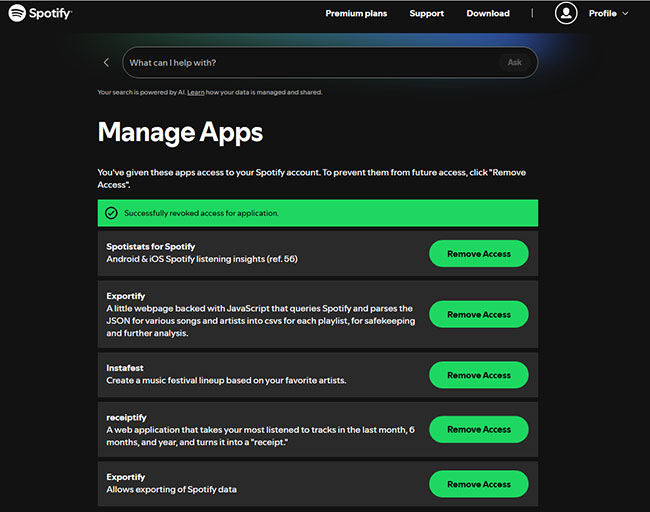
Exportify requires OAuth access to your Spotify account. You can go to your Spotify Account Settings -> "Manage Apps" and remove its access after your backup is complete.
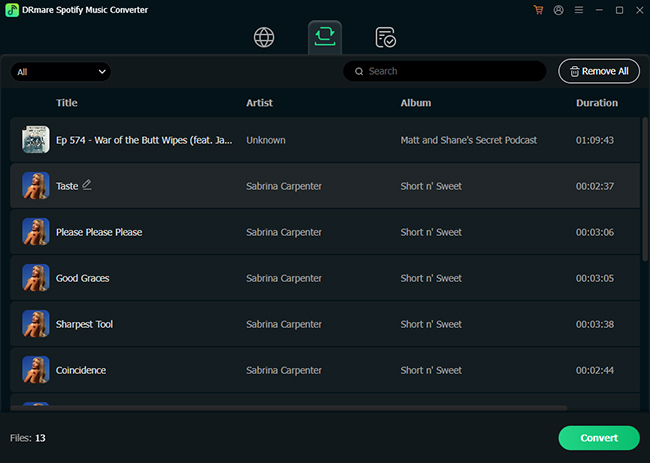
Method 4. Backup and Restore Spotify Library for Free with DRmare
Unlike online converters that only support raw data export, DRmare Spotify Music Converter offers a complete two-tier backup solution: a 100% free built-in feature to back up and restore your Spotify account data, plus an advanced mode to save physical audio files onto your local hard drive.
Method 1. Free 1-Click Spotify Library Backup & Restore (No Purchase Required)
If you just want to safeguard your curated playlists against accidental deletion or account issues:
Step 1. Launch DRmare Spotify Music Converter and log into your Spotify account.
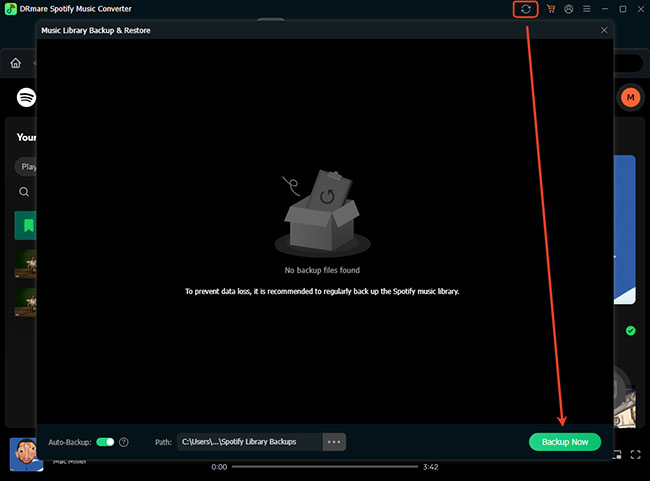
Step 2. Click the Music Library Backup & Restore icon in the top-right menu.
Step 3. Click Backup Now to save your entire Spotify library metadata to your computer.
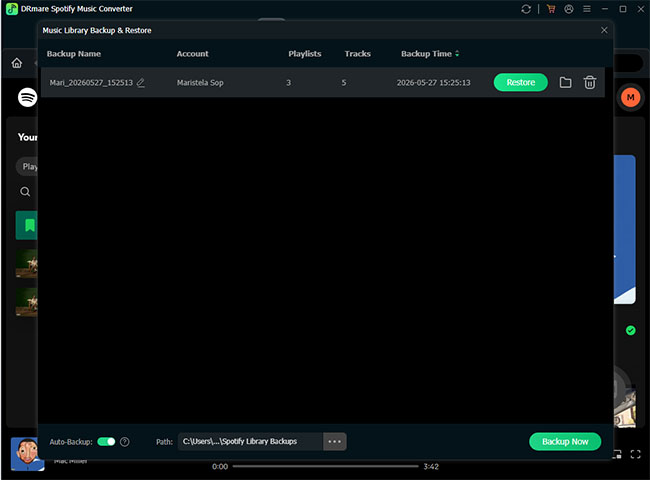
To Restore: If your library is lost, simply open the tool, navigate to the backup history, select your backup, and click Restore to recover all playlists back to Spotify instantly.

Security Note:
Unlike web-based tools that require granting access via online browsers, DRmare processes your backup locally, keeping your account credentials safe from third-party server risks.
Method 2: Save Spotify Songs as Local MP3 Files (Advanced Local Archive)
If you prefer creating a permanent Spotify audio archive that plays on any media player offline:
Step 1. Select your target Spotify playlists or tracks within the built-in web player.
Step 2. Set your output format (e.g., MP3, FLAC, WAV) in Preferences.
Step 3. Click Convert to download Spotify audio files directly to your Windows or Mac drive.
FAQs About Spotify Playback Backup
What does a Spotify playlist backup actually save?
A standard backup saves playlist metadata, such as track titles, artists, albums, exact playlist order, and track URIs/IDs, rather than the playable audio files. For the most accurate recovery, always choose export formats that preserve Spotify URIs or ISRCs instead of just plain text song titles.
What happens if I accidentally delete a Spotify playlist?
Don't panic. Spotify natively stores deleted playlists in your account settings, allowing for a quick recovery within 90 days. However, for long-term protection, cross-platform migration, or safeguarding against account loss, you must rely on your own local backup files.
How can I ensure my Spotify playlist backups are reliable?
You can bulletproof your backups by following a few simple practices: always export formats containing precise Spotify URIs/IDs, keep multiple copies (one local, one in cloud storage), schedule regular backup snapshots to capture new additions, and occasionally open your exported files to verify the data is fully intact before an emergency strikes.
In Conclusion
Backing up a Spotify playlist is less about saving the music itself and more about preserving the work you've put into organizing it. For most users, the key information is the playlist structure and track metadata. You can choose the right Spotify backup tool depends on your specific needs:
- Spotify "Download Your Data": Best for an official, text-based archive, though restoring playlists from its raw JSON files is difficult.
- Exportify, TuneMyMusic & Soundiiz: Ideal for exporting readable CSV/Excel files for spreadsheet viewing or migrating to other streaming platforms.
- DRmare (Free Mode): The safest option for 1-click metadata recovery. It bypasses web server risks by processing your backup and restore entirely on your local machine.
- DRmare (Premium Spotify Music Converter): The ultimate safeguard for true digital ownership. It downloads permanent MP3 or FLAC files to your hard drive for offline, unrestricted listening.
Note:
SpotMyBackup is currently broken due to Spotify OAuth errors and should be avoided.
Whichever route you choose, back it up today; your future self will thank you.

 Home
Home





User Comments
Leave a Comment